Navigating Headwinds
Hello Everyone,
I hope your summer was full of fun and a little well-deserved decompression. Ours certainly was—filled with plenty of pool time to beat the heat and a few much-needed getaways to the mountains and the coast. The girls loved every bit of it, especially now that we’re officially a family of five. Olivia has been thriving in school (and showing a real knack for math), Emma Joy is still singing Frozen songs on repeat, and little Leah Mae is all smiles—likely just days away from crawling.
In many ways, the market's been doing the same thing: pushing forward through heat, ambiguity, and noise. As we head into Q4, it’s time to reflect on what kept the market strong, what’s adding risk, and where opportunity still lies.
Technical Market Outlook
From a technical vantage point, at this juncture, the picture is still constructive for US Stocks. Yet, caution has entered the market. Since Q2’s rebound, breadth has improved, with more sectors participating in the rally—a favorable sign.
However, we’re bumping into resistance zones and overbought conditions. Couple that with the current concerns of bank credit markets and we may be starting a consolidation phase in equities to kick off the 4th quarter.
What we are closely monitoring:
Broad Market relative strength between cyclical, growth, and defensive sectors
Key support levels on major indices
Momentum indicators, volume confirmation, and sector rotations
As these measures hold, the uptrend remains credible; if they crack, we’ll regard them as early warning signals and make changes accordingly.
Yet, despite the potential for a consolidation there are some potentially noteworthy areas of strength in the broader “markets” we should continue to pay attention to.
For instance, a chart (below) comparing the performance of International Stock versus U.S. Stocks is one such noteworthy scenario.
Improvement of relative strength in Int. equities versus US equities is an important development to keep our eye on.

International equity performance Vs. U.S. equity performance.
In addition, look at this chart of gold relative to US equities. The strength in gold has continued push forward for the last few years. Of course, this is not a brand-new development but noteworthy to watch nontheless.
Perhaps, this is related to the continued renewal of geopolitical tensions and world central banks hoarding the precious metal. Given the momentum, this could continue for some time even amongst pullbacks in precious metals.
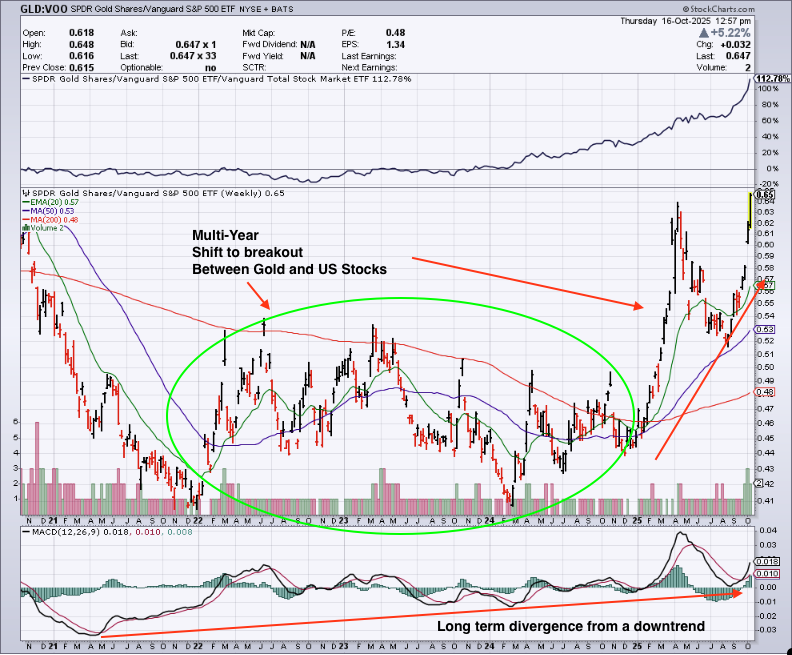
Side note: We’ve held both of these positions for a while now. If you’re a client, you already know that international equities and gold have been part of your portfolio.
Headwinds
1. Consumer Spending Softened
Signs suggest that services spending— historically a pillar of economic growth—is starting to decelerate. After years of pull-forward demand, many households are now tightening. For example, while nominal retail sales in August rose ~0.6% month-over-month, much of that reflects rising prices rather than volume growth.
Real, inflation-adjusted gains are underwhelming.
If consumers continue to pare back discretionary and service purchases, the drag on GDP could become more visible heading into 2026.
2. Interest Rates – Continued Trade disputes
Though headline inflation has cooled from its highs, underlying pressures—in housing, services, wages—remain sticky. The return of tariff intermittency only muddies the waters further, raising the risk that supply shocks or imported costs reignite inflation expectations. Making the rate cut argument ambiguous.
Markets don’t appear to be fully pricing in such a surprise, which leaves room for volatility if inflation data comes in hotter than anticipated.
3. Valuations are Elevated
Equities continue to trade at elevated valuations, especially in sectors deeply tied to AI, momentum, and liquidity flows. When markets are priced for perfection, even minor disappointments can lead to outsized reactions.
In an environment where consumer growth is softening and inflation risks persist, this valuation cushion is thinner than it appears.
4. AI & Labor Market Disruption
One of the emerging risks often under-discussed is the tension between AI adoption and shifts in the labor market. As AI technologies become more embedded across industries, we’re beginning to see pressure in certain job categories—particularly routine administrative, back-office, and service roles.
Goldman Sachs estimates that generative AI could displace ~6–7 % of the U.S. workforce in a mature adoption scenario. A St. Louis Fed analysis further shows that occupations with higher AI exposure have experienced greater upticks in unemployment rates, even after controlling for other factors.
While the aggregate labor market remains resilient, these pockets of disruption can ripple through wage growth, confidence, and future consumption patterns.
5. Rising Geopolitical Tensions and Gold’s Signal
Across Europe, defense posturing is quietly intensifying. Several countries are revisiting conscription laws and boosting military spending amid renewed security concerns. The U.S., too, has adopted a firmer stance—deploying naval assets off Venezuela’s coast and authorizing expanded “counternarcotics” operations that Caracas has labeled provocative.
Historically, gold prices tend to rise in periods of geopolitical tension—not as a predictor of war, but as a reflection of market unease. The recent uptick in gold underscores investors’ growing focus on safety amid an increasingly uncertain global backdrop.
Government Shutdown: A Wildcard in the Mix
As of October 1, 2025, the U.S. government has entered a partial shutdown. Over 900,000 federal workers are furloughed or working without pay, while essential agencies operate at reduced capacity.
Economic modeling suggests a multi-week shutdown could subtract ~0.3 percentage points from quarterly GDP, with additional drag if it elongates. The repercussions stretch beyond mere economics—delayed regulatory approvals, postponed data releases, and a rising confidence tax could amplify volatility in what is already a sensitive backdrop.
Historically, markets have absorbed short shutdowns without collapse. But given the other headwinds present, each extra day of gridlock carries outsized risk.
Market Resilience — With Caveats
Despite these headwinds, the capital markets have shown impressive fortitude. Equity indices hover near all-time highs, volatility remains contained (for now), and leadership has broadened beyond top tech names.
Yet, volatility has ticked high in the last few days. Banking sector credit weakness in a topic of recent concern and the market has shown reason
for a pause here.
Looking Ahead & Final Thoughts
Despite these headwinds, the capital markets have shown impressive fortitude. Equity indices hover near all-time highs, and leadership has broadened beyond top tech names.
That structural resilience speaks to the durability of the secular bull thesis (which we’ve referenced in past outlooks) and the base of positive tailwinds still alive in the background.
No matter the environment, our approach remains unchanged: stay vigilant, remain flexible, keep an eye out for opportunity and use disciplined decision-making rooted in each clients’ long-term objectives.
As always, thank you for your trust and partnership and, Thank you for reading.
James Anadon